Frequently Asked Questions About Staff Augmentation and Staff Outsourcing
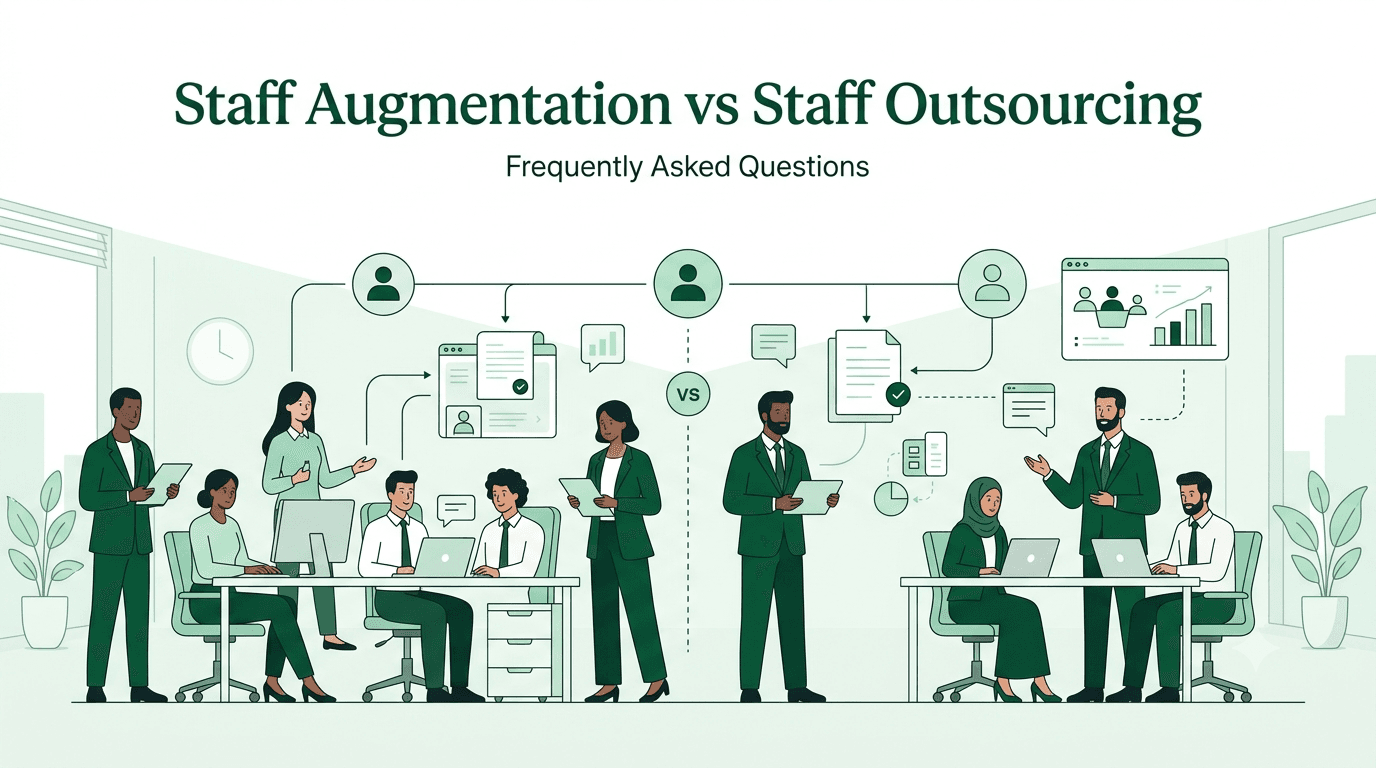
As businesses grow, they often need skilled professionals faster than traditional hiring processes can provide. Two popular workforce solutions are staff augmentation and staff outsourcing. While the terms are sometimes used interchangeably, they represent different approaches to managing talent, responsibilities, and workforce operations.
For companies expanding across the UAE, Saudi Arabia, Qatar, and the wider GCC, understanding the difference can help determine the right workforce strategy.
This guide answers the most frequently asked questions about staff augmentation and staff outsourcing, including how they work, their benefits, costs, compliance considerations, and when businesses should use each model.
What Is Staff Augmentation?
Staff augmentation is a workforce model where a company adds external professionals to its existing team to address specific skill, capacity, or project requirements.
The external professionals work alongside the company's internal employees and generally follow the client's existing workflows, management structure, and project objectives.
For example, a company may need:
- Software developers for a six-month project
- Accountants during a busy financial period
- Supply chain specialists during expansion
- Customer service professionals during seasonal demand
- HR professionals for a specific transformation project
Instead of permanently hiring additional employees, the company can augment its existing workforce with qualified professionals.
What Is Staff Outsourcing?
Staff outsourcing involves transferring specific workforce functions, operational responsibilities, or business processes to an external service provider.
Rather than simply adding professionals to an internal team, the outsourcing provider may take responsibility for managing a defined function or workforce operation.
Examples include:
- Payroll administration
- Customer support
- Recruitment operations
- Back-office administration
- Accounting support
- HR administration
- IT support
- Logistics operations
The outsourcing provider typically manages some or all of the operational responsibilities associated with the outsourced function.
What Is the Difference Between Staff Augmentation and Staff Outsourcing?
The main difference is who controls the day-to-day work and responsibility for the function.
| Factor | Staff Augmentation | Staff Outsourcing |
|---|---|---|
| Primary purpose | Add talent to an existing team | Transfer a function or operation |
| Day-to-day management | Usually client | Usually outsourcing provider |
| Team integration | High | Varies |
| Scope | Individuals or specific skills | Functions, processes, or teams |
| Client control | High | Lower |
| Best for | Projects and capacity gaps | Operational efficiency |
| Workforce flexibility | High | High |
| Responsibility | Shared | More provider-led |
In simple terms:
Staff augmentation = "Give us the people we need."
Staff outsourcing = "Manage this function for us."
Frequently Asked Questions
1. Why Do Companies Use Staff Augmentation?
Companies commonly use staff augmentation when they need additional talent without committing to permanent recruitment.
It can help businesses:
- Scale teams quickly
- Access specialized skills
- Handle temporary increases in workload
- Reduce recruitment timelines
- Support new projects
- Fill short-term talent gaps
- Enter new markets more efficiently
It is particularly useful when the business already has strong internal management but needs additional people to execute its plans.
2. Why Do Companies Choose Staff Outsourcing?
Staff outsourcing is often used when a company wants an external provider to take responsibility for a particular function or workforce operation.
Businesses may outsource because they want to:
- Reduce administrative workload
- Access specialized operational expertise
- Improve process efficiency
- Control operating costs
- Focus internal teams on core business activities
- Scale operations without building large internal departments
For example, a growing company may decide to outsource payroll administration rather than build a dedicated payroll department.
3. Is Staff Augmentation the Same as Outsourcing?
No.
Although both models involve external talent, their operating structures are different.
With staff augmentation, external professionals typically become an extension of the client's existing team. The client generally determines their daily priorities, workflows, and project responsibilities.
With staff outsourcing, the provider usually takes greater responsibility for managing the outsourced function, process, or workforce.
The correct model depends on how much operational control the business wants to retain.
4. Who Manages Augmented Employees?
In a traditional staff augmentation arrangement, the client generally manages the professionals on a day-to-day basis.
The staffing or workforce provider may handle responsibilities such as:
- Recruitment
- Employment administration
- Payroll
- Documentation
- Visa processing
- Benefits administration
- Compliance support
The client, however, typically directs the employee's actual work.
This makes staff augmentation attractive for companies that want external talent while maintaining internal management control.
5. Who Manages Outsourced Staff?
This depends on the outsourcing agreement.
In many outsourcing arrangements, the external provider manages the employees and the associated operational processes.
For example, if customer support is outsourced, the provider may manage:
- Hiring
- Training
- Scheduling
- Performance management
- Workforce administration
- Operational reporting
- Quality control
The client typically focuses on defining business requirements, service expectations, KPIs, and outcomes.
6. Is Staff Augmentation Suitable for Short-Term Projects?
Yes.
Staff augmentation is particularly effective when workforce requirements are temporary or project-based.
For example, a company launching a new digital platform may need additional developers for eight months. Instead of permanently expanding its engineering department, it can bring in additional professionals for the duration of the project.
Once the project is completed, the workforce requirement can be adjusted.
7. Can Staff Augmentation Be Used for Long-Term Roles?
Yes.
Staff augmentation does not necessarily mean short-term employment.
Businesses can use augmented professionals for longer-term requirements when they need additional capacity but want to maintain flexibility in workforce planning.
The important consideration is ensuring that the employment structure, contractual arrangements, and local regulations are properly addressed.
8. Is Staff Outsourcing Only for Large Companies?
No.
Small and medium-sized businesses can also benefit from outsourcing.
In fact, outsourcing can be particularly valuable for growing companies that do not yet have the resources to build large internal departments.
A smaller company might outsource:
- Payroll
- Recruitment
- HR administration
- Customer support
- Accounting
- Administrative operations
This allows the company to access specialized resources without necessarily creating a full internal function.
9. How Does Staff Augmentation Help With Hiring?
Staff augmentation can shorten the time required to access qualified professionals because businesses can work with an external workforce provider instead of managing the entire recruitment process internally.
Depending on the provider and arrangement, the process may include:
- Understanding the workforce requirement
- Defining the required skills
- Candidate sourcing
- Screening and evaluation
- Interviews
- Selection
- Employment documentation
- Onboarding
- Payroll and workforce administration
This can help companies respond more quickly to changing workforce requirements.
10. What Are the Benefits of Staff Augmentation?
Key benefits include:
Faster Access to Talent
Companies can potentially access qualified professionals without building a long recruitment pipeline from scratch.
Greater Workforce Flexibility
Businesses can increase or decrease workforce capacity according to operational requirements.
Specialized Skills
Companies can access professionals with specific technical or functional expertise.
Greater Management Control
The client generally maintains direct control over the augmented employee's day-to-day work.
Reduced Administrative Burden
Depending on the model, the workforce provider may manage employment administration, payroll, documentation, and related processes.
11. What Are the Benefits of Staff Outsourcing?
Staff outsourcing offers a different set of advantages.
Operational Efficiency
Specialized providers can manage processes using established systems and expertise.
Reduced Internal Administration
The business can transfer selected operational responsibilities to an external provider.
Access to Specialized Expertise
Outsourcing providers may already have established teams, processes, and infrastructure.
Focus on Core Business
Internal management can concentrate on strategic priorities rather than administrative functions.
Scalability
Outsourced operations can often be expanded as business requirements increase.
12. Which Is More Cost-Effective: Staff Augmentation or Outsourcing?
There is no universal answer.
The cost depends on factors such as:
- Number of professionals
- Skill level
- Country of employment
- Employment structure
- Duration
- Benefits
- Payroll requirements
- Management responsibilities
- Compliance requirements
- Scope of outsourced services
Staff augmentation can be more suitable when a company needs a specific number of professionals while maintaining operational control.
Outsourcing may be more appropriate when the company wants an entire function or process managed externally.
The right comparison should therefore consider total cost of ownership, not simply the monthly cost per employee.
Staff Augmentation vs. Staff Outsourcing: Which Should You Choose?
A simple decision framework can help.
Choose Staff Augmentation When:
- You need additional employees
- Your internal managers can manage the team
- You need specialized skills
- You want direct control over projects
- Your workforce requirement may change
- You want to scale without permanent recruitment
Choose Staff Outsourcing When:
- You want to transfer responsibility for a function
- Your internal team lacks operational capacity
- You want an external provider to manage the workforce
- You want to reduce administrative workload
- You are looking for process-based delivery
- You want to focus internal resources on core business activities
How Does Staff Augmentation Work in the GCC?
Expanding into the GCC involves more than simply finding candidates.
Businesses may need to consider:
- Employment structures
- Work permits
- Visa and immigration requirements
- Local employment regulations
- Payroll
- Employee benefits
- Contracts
- Mandatory insurance
- Government registrations
- End-of-service obligations
- Documentation requirements
This is particularly important when hiring international professionals who need to relocate to countries such as the UAE, Saudi Arabia, or Qatar.
A workforce partner can help businesses navigate these administrative and compliance requirements.
Can Staff Augmentation Support International Hiring?
Yes.
International staff augmentation can allow companies to access talent from different countries while using a local workforce infrastructure for employment and administration.
For example, a business expanding into the UAE may identify a professional in India, Bangladesh, Pakistan, Nepal, or another international market.
A workforce partner can potentially support areas such as:
Talent sourcing → Candidate screening → Employment setup → Visa & immigration → Payroll → Benefits → Compliance → Employee administration
This can significantly simplify international workforce expansion.
What Is an Employer of Record and How Does It Relate to Staff Augmentation?
An Employer of Record (EOR) is a service model where a third-party organization becomes the legal employer of a worker while the client company retains responsibility for the employee's day-to-day work.
An EOR can typically support:
- Employment contracts
- Payroll
- Tax and statutory administration
- Benefits
- Employee records
- Work permits and visas, where applicable
- Local employment compliance
This structure can be useful for businesses that want to hire employees in a country where they do not have an established legal employing entity.
However, EOR, staff augmentation, and outsourcing are not identical concepts.
They describe different aspects of workforce management and can sometimes be used together.
Can Citizen Help With Staff Augmentation?
Yes. Citizen EOR can support businesses that need to build and manage teams across the GCC.
Through workforce, EOR, payroll, visa, immigration, and compliance support, Citizen can help businesses simplify the administrative side of international hiring and workforce expansion.
Depending on the business requirement, the solution can support areas such as:
- International talent hiring
- Employee onboarding
- Employment administration
- Payroll management
- Visa and immigration support
- Workforce compliance
- Employee benefits
- Relocation support
- GCC market expansion
This allows companies to focus on managing their business and teams while reducing the administrative complexity associated with international employment.
Final Thoughts
Staff augmentation and staff outsourcing are both valuable workforce strategies, but they solve different problems.
Staff augmentation is primarily about adding people to your existing team.
Staff outsourcing is primarily about transferring responsibility for a function or operation to an external provider.
The right approach depends on your workforce requirements, management structure, operational objectives, budget, and desired level of control.
For companies expanding across the GCC, these models can also be combined with EOR, payroll, immigration, and compliance services to create a more flexible international workforce strategy.
The key is not simply choosing between augmentation and outsourcing. It is choosing the workforce model that gives your business the right talent, the right level of control, and the right operational structure for sustainable growth.
Need help building your GCC workforce?
Citizen EOR helps businesses hire, employ, relocate, and manage talent across the GCC while simplifying payroll, immigration, and employment compliance.
Explore how Citizen can support your next stage of workforce expansion.
Written by Al Abdellah
Expert insights on global payroll, compliance, and distributed team management from the CITIZEN EOR team.
Related Articles
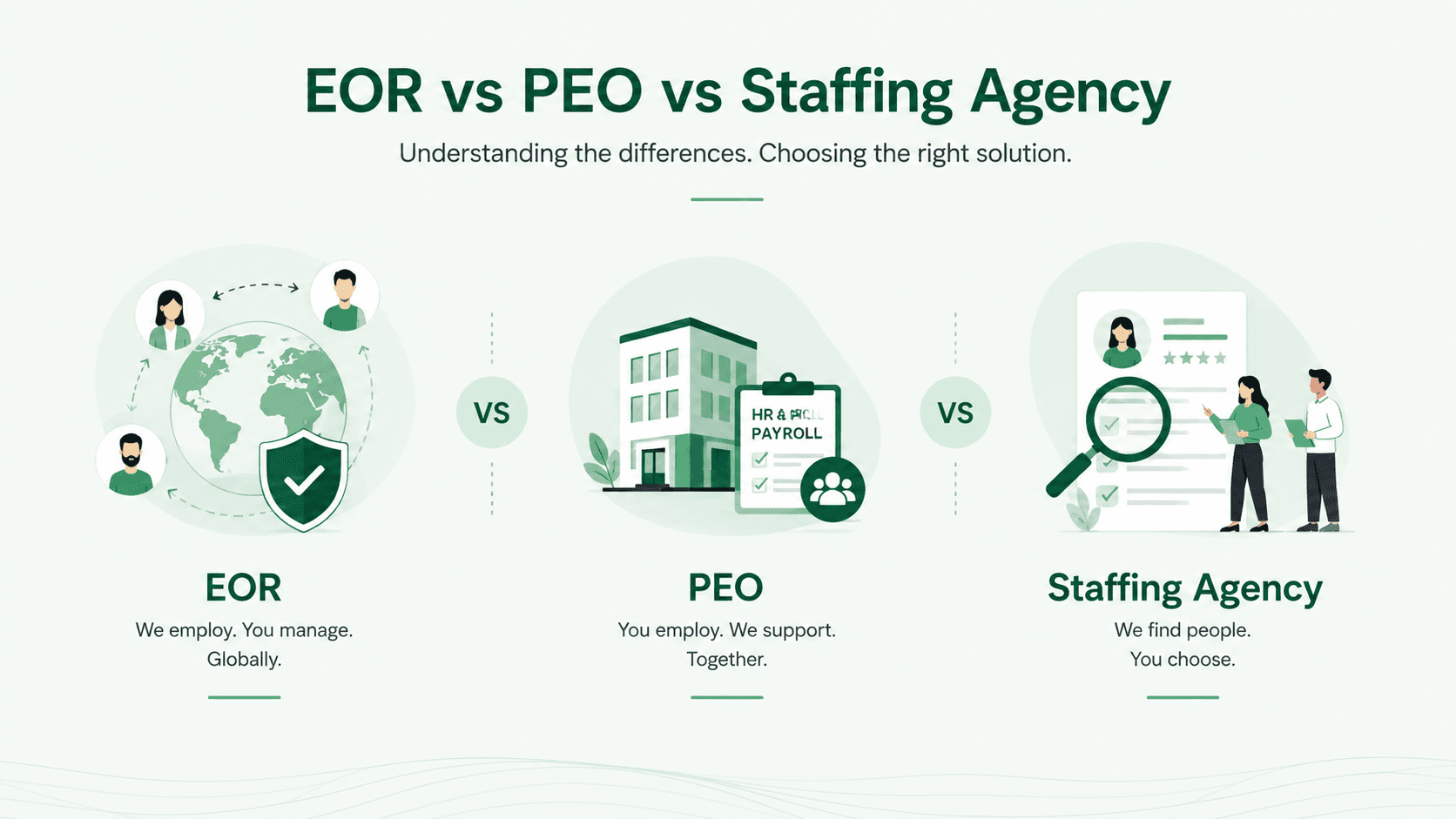
EOR vs PEO vs Staffing Agency: Key Differences Explained (2026)
Understanding the differences between an Employer of Record (EOR), Professional Employer Organization (PEO), and Staffing Agency is essential for choosing the right hiring strategy. While an EOR enables businesses to hire internationally without establishing a local entity, a PEO supports companies that already have a legal presence by managing HR functions. A Staffing Agency, on the other hand, focuses primarily on recruiting temporary or permanent talent. This guide compares each model, highlights their benefits and use cases, and explains how Citizen helps businesses hire globally with compliant EOR, payroll, and workforce solutions.
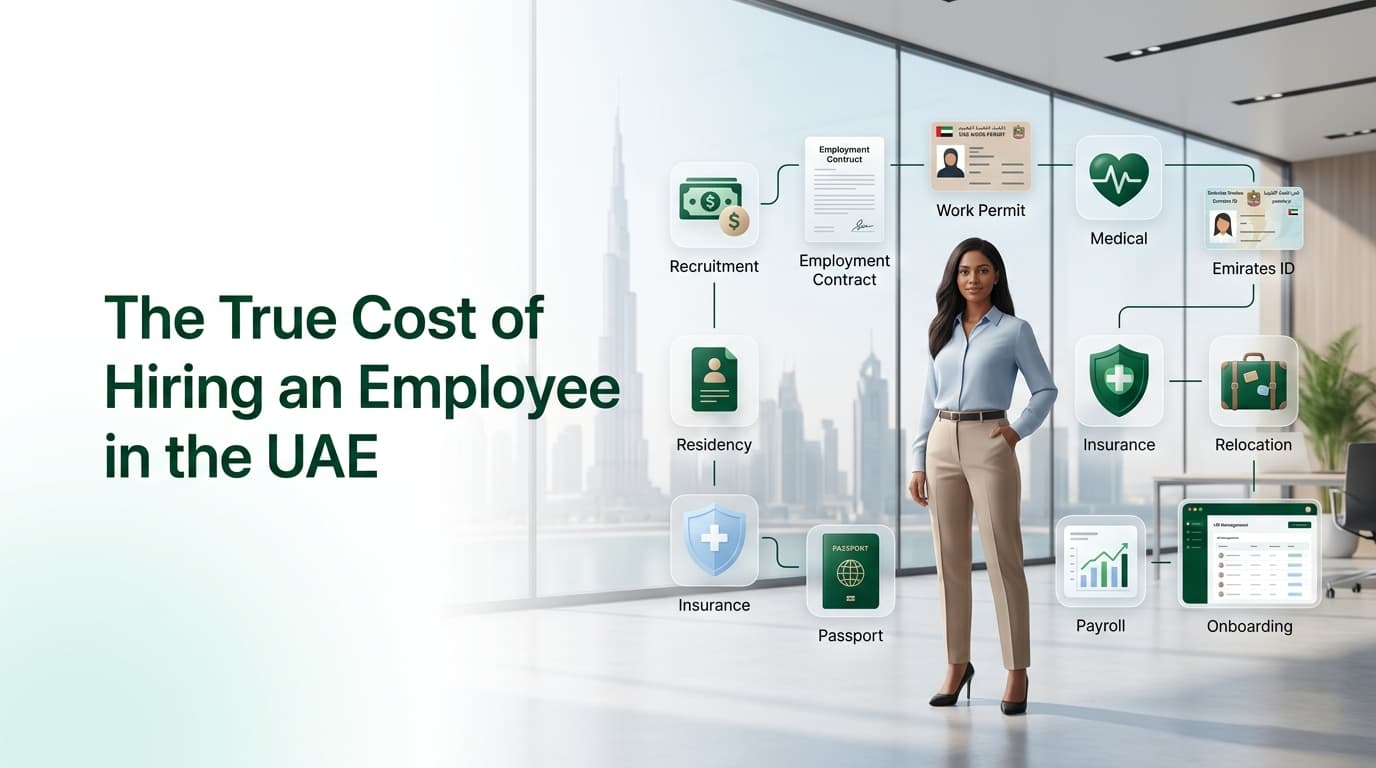
The True Cost of Hiring an Employee in the UAE: A Complete Employer Guide
Hiring in the UAE involves far more than an employee’s monthly salary. Employers must account for the full cost of employment, including recruitment, work permits, immigration, medical fitness, Emirates ID, residency, health insurance, relocation, payroll, employee benefits, equipment and ongoing HR administration. This guide helps HR leaders, finance teams and business owners understand the true cost of hiring in the UAE, identify often-overlooked expenses and plan the employee onboarding journey more effectively. For international companies, understanding these costs upfront is especially important when relocating talent into the UAE.
Will AI Replace Customer Service? Why the Human Touch Still Matters
AI is transforming customer service, but does that mean humans are becoming obsolete? From chatbots and automation to complex complaints and relationship management, discover how AI can improve efficiency while human professionals continue to provide the empathy, judgment, and personal connection customers value most.
Get global HR insights delivered to your inbox
Join thousands of founders and HR leaders staying ahead of global compliance and hiring trends.